This post is an answer to the Case – Fever, Haemolysis, and Thrombocytopenia in Pregnancy
A 44-year-old woman, 35 weeks pregnant with dichorionic, diamniotic twins—was admitted to our hospital with 7-day history of fever, weakness, and shortness of breath. Notably in the week before, the patient had been seen twice by her obstetrician and found to have normal or low blood pressure along with a fever. She had no other unusual medical history.
On examination, the patient was pale and breathless; her temperature was 38,8°C, blood pressure was 110/60 mm Hg, and she had petechiae scattered about her body with oedema of both legs.
Laboratory investigations showed a haematocrit of 31,3% (normal >35), an elevated aspartate aminotransferase (AST) concentration of 110 units per L (normal <40), alanine aminotransferase (ALT) was normal, total bilirubin concentration of 1,7 mg/dL (normal <1,2), a platelet count of 17 × 109 (normal >150), and a 3+ proteinuria. A transvaginal ultrasound scan showed vertex twins and a marginal placenta praevia. A peripheral blood smear showed intraerythrocytic parasites—Babesia microti, with a 19,3% parasitaemia.
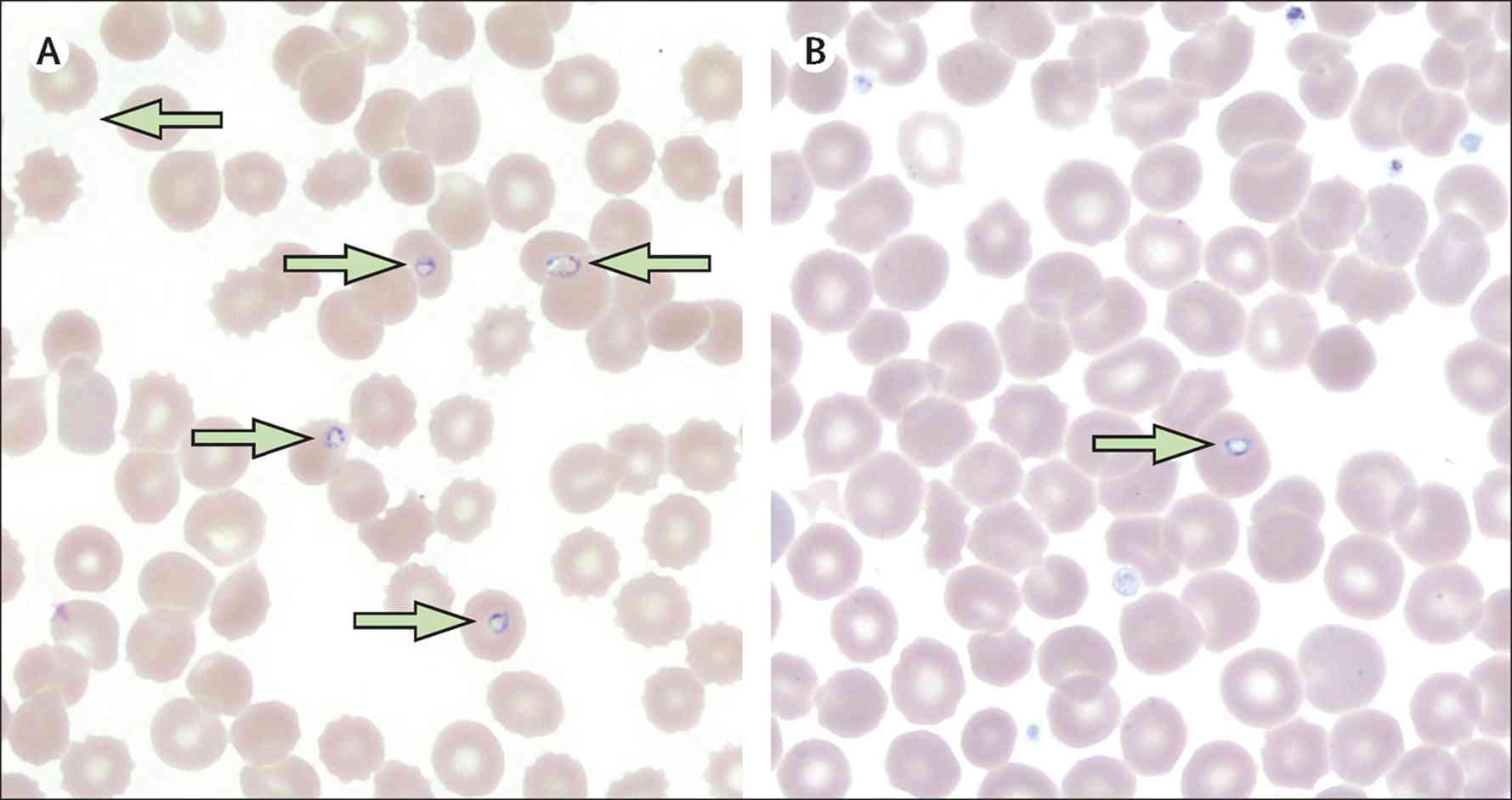
(B) Blood smear of twin A’s peripheral blood on day 4 of life, shows one B microti ring-form (Giemsa stain).
The patient was transfused platelets and packed red blood cells and treated for babesiosis with a combination of intravenous clindamycin and oral quinine, which notably cross the placenta. An emergency caesarean was performed the next day; she delivered healthy twin boys who were monitored with daily B microti PCRs and blood smears.
On day 4 of the admission, a single B microti ring-form was identified in twin A’s smear (image) and on the same day his B microti PCR became positive. Twin B’s B microti smear and PCR remained negative. To prevent symptomatic disease, the twins were treated with oral azithromycin and oral atovaquone.
After the delivery of her twins, the patient had a complicated course of severe babesiosis and eventually after 12 days in hospital she was able to go home; the twins never became symptomatic.
Initially, we considered that our patient might have had a diagnosis of HELLP—Haemolysis, Elevated Liver enzymes, and Low Platelets—syndrome. However, the low to normal blood pressure and normal ALT, which indicated no liver injury, made us think again. Additionally, HELLP is usually preceded by hypertension without fever. Furthermore, blood smears in HELLP may show schistocytes and burr cells, but in this case, we found intraerythrocytic parasites.
The differential diagnosis for HELLP syndrome includes fatty liver of pregnancy, haemolytic uraemic syndrome, thrombotic thrombocytopenic purpura, immune thrombocytopenia, and systemic lupus flare-up—none of these fitted in this case.
Babesiosis is endemic in the New England region of the USA, including Connecticut. Most cases are asymptomatic; asplenic and immunosuppressed individuals, pregnant patients, and the very young (<2 months) and very old (>80 years) are prone to develop symptoms and may have severe disease. Vertically acquired babesiosis, as occurred in twin A, is very rare. In endemic areas, babesiosis should be considered in the list of differential diagnoses of a HELLP-like presentation. The peripheral blood smear should lead to the diagnosis.