
This post is an answer to the Case – Hyperpigmentation and Fatigue
A 40-year-old woman attended our hospital complaining of excessive darkening over her fingers and toes, and on the palms of her hands, and the soles of her feet: she also said she got tired easily, had a burning sensation in her mouth, and had become increasingly forgetful over the past 12 months. Additionally, she reported having chest pain brought on by exertion for the past 2 months.
She had no medical history suggesting malabsorption, recurrent epigastric pain suggesting a hookworm infestation, or blood loss. She said her diet was strictly vegetarian, as advised by the local Ayurvedic practitioner, and mainly comprised chapattis and dhal, with no fruit, milk, or vegetables.
A physical examination confirmed deep brownish-black pigmentation over her fingers and toes, and on the palms of her hands, and soles of her feet (figure). Her scalp hair was brittle, her tongue was bald with brown pigmented spots, and she had brown pigmented spots all around the inside of her mouth.
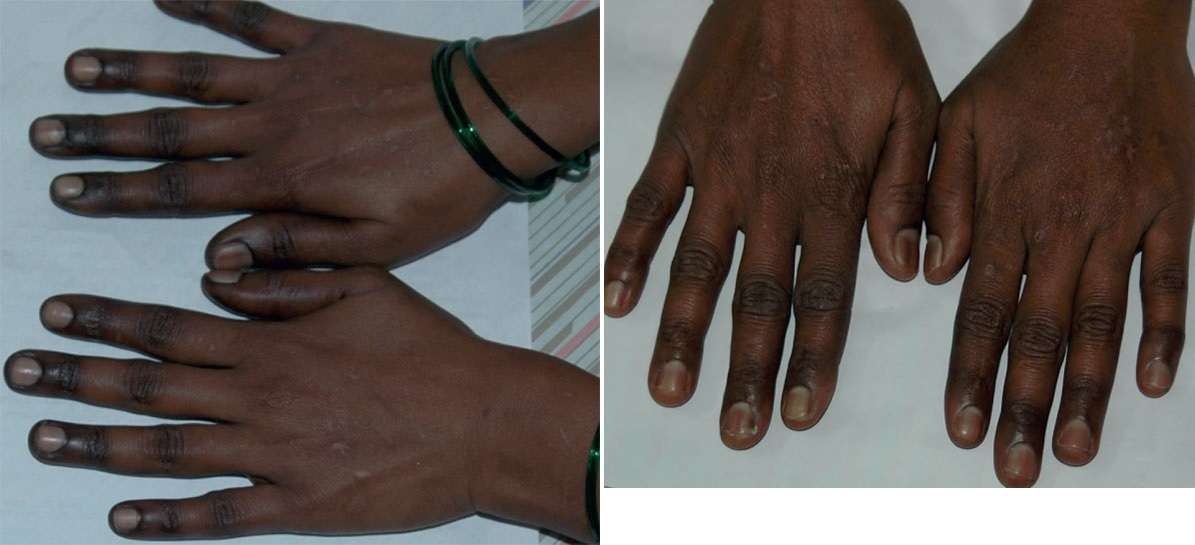
Examination of her cardiovascular system found a soft systolic murmur at the apex and a fourth heart sound. Neurological examination found diminished deep tendon reflexes with intact peripheral sensation. Romberg’s sign was absent.
Laboratory investigations showed a haemoglobin concentration of 8 g/dL, macrocytosis (mean corpuscular volume 107,9 fL), and white cell count 3,4 × 10⁹ per L. A peripheral blood smear showed oval macrocytes, fragmented and teardrop shaped red blood cells, and hypersegmented neutrophils (figure). Serum folate concentration was 14,2 ng/mL (normal range 3–17), serum B12 concentration was less than 83 pg/mL (normal range 174–878), and serum homocysteine concentration was 34,69 μmol/L (normal range <15).
A 12-lead electrocardiogram showed biphasic T waves in leads V1–V3. A coronary angiogram showed critical proximal stenosis in the left anterior descending coronary artery.
The patient was treated with oral B12 supplements, statins, and antiplatelets, and advised to have a protein rich diet, with fruits and vegetables. 3 months later, her symptoms had greatly improved: the pigmentation of her skin was markedly reduced (figure) and her haemoglobin concentration had increased to 10,4 g/dL, with improvement in all red blood cell indices.
READ MORE: Anemia: Approach and Evaluation